Intelligent Mobile Support

  • Subscribe to our RSS feed.
  • Twitter
  • StumbleUpon
  • Reddit
  • Facebook
  • Digg

Tuesday, 29 June 2004

Context Broker Architecture (CoBrA)

Posted on 03:59 by Unknown


Context Broker Architecture (CoBrA): "an agent based architecture for supporting context-aware systems in smart spaces (e.g., intelligent meeting rooms, smart homes, and smart vehicles). Central to this architecture is an intelligent agent called context broker that maintains a shared model of context on the behalf of a community of agents, services, and devices in the space and provides privacy protections for the users in the space by enforcing the policy rules that they define. "


Department of Computer Science and Electrical Engineering (CSEE), UMBC.

Read More
Posted in | No comments

Project DIAMOnDS :: Distributed Agents for Mobile & Dynamic Services

Posted on 03:50 by Unknown
Distributed Agents for Mobile & Dynamic Services (DIAMOnDS): "The use of agents allows execution of complex operations that involves large amounts of data to be done effectively using distributed resources.

(...)

This project will provide a secure and flexible distributed services management infrastructure which can be used for communications and coupling of distributed services used in CERN CMS community."


NUST Institute of Information Technology
Read More
Posted in | No comments

Friday, 25 June 2004

Towards an intelligent mobile travel assistant (Paper)

Posted on 06:09 by Unknown
Towards an intelligent mobile travel assistant: "Travel has many situations where context-aware computing can bring important benefits. In this paper, we describe an approach for integrating context-aware computing to a mobile travel assistant. Travel plans, generated using reality [2], are enriched within compact and powerful structures, called User Task Models. These structures are transferred to a mobile device enabling the support for the traveler during his trip. "


Marc Torrens and Patrick Hertzog and Pearl Pu and Boi Faltings

Proceedings of the 2004 ACM symposium on Applied computing

pp 1208--1209. Nicosia, Cyprus. 2004.


Read More
Posted in | No comments

Tuesday, 22 June 2004

Portolano Project

Posted on 18:48 by Unknown

The Portolano project seeks to create a testbed for investigation into the emerging field of invisible computing. Invisible computing is a term invented by Donald Norman to describe the coming age of ubiquitous task-specific computing devices. The devices are so highly optimized to particular tasks that they blend into the world and require little technical knowledge on the part of their users.


University of Washington
Read More
Posted in | No comments

Endeavour Project :: Charting the Fluid Information Utility

Posted on 18:39 by Unknown
Endeavour Project Home Page: "Our Mission: Achieve nothing less than radically enhancing human understanding through the use of information technology, by making it dramatically more convenient for people to interact with information, devices, and other people. We will achieve this by developing a revolutionary Information Utility, able to operate at planetary scale. To validate the architecture, we will stress it under demanding applications for rapid decision making and learning. In addition, we will develop new methodologies for the construction and administration of systems of this unprecedented scale and complexity. Our success will be measured by how effectively our architecture actually amplifies and leverages human intellect."


University of California, Berkeley
Read More
Posted in | No comments

Project Aura :: Distraction-free Ubiquitous Computing

Posted on 18:37 by Unknown
"Project Aura will fundamentally rethink system design to address this problem. Aura's goal is to provide each user with an invisible halo of computing and information services that persists regardless of location. Meeting this goal will require effort at every level: from the hardware and network layers, through the operating system and middleware, to the user interface and applications. "


Carnegie Mellon University
Read More
Posted in | No comments

Sunday, 20 June 2004

HP Cooltown

Posted on 07:21 by Unknown
HP Cooltown: "(...) the intersection of nomadicity, appliances, networking, and the web. We called our vision of the future cooltown - a vision of a technology future where people, places, and things are first class citizens of the connected world, wired and wireless - a place where e-services meet the physical world, where humans are mobile, devices and services are federated and context-aware, and everything has a web presence.

For several years, HP Labs has been working at the intersection of nomadicity, appliances, networking, and the web. We called our vision of the future cooltown - a vision of a technology future where people, places, and things are first class citizens of the connected world, wired and wireless - a place where e-services meet the physical world, where humans are mobile, devices and services are federated and context-aware, and everything has a web presence.


In cooltown, technology transforms human experience from consumer lifestyles to business processes by enabling mobility. Cooltown is infused with the energy of the online world, and web-based appliances and e-services give you what you need when and where you need it for work, play, life."
Read More
Posted in | No comments

Thursday, 17 June 2004

Network abstractions for context-aware mobile computing

Posted on 20:05 by Unknown
"This paper explores context-aware computing in the setting of ad hoc networks consisting of numerous mobile hosts that interact with each other opportunistically via transient wireless interconnections. We extend the context to encompass awareness of an entire neighborhood within the ad hoc network. A formal abstract characterization of this new perspective is proposed. The result is a specification method and associated context maintenance protocol."


Gruia-Catalin Roman and Christine Julien and Qingfend Huang

Network abstractions for context-aware mobile computing

Proceedings of the 24th international conference on Software engineering
Read More
Posted in | No comments

GRASS: GeneRic Architectures for Smart Spaces

Posted on 20:01 by Unknown
Project GRASS:: "The work carried out under GRASS aims to produce frameworks to support development of context-aware systems for deployment in mobile and ubiquitous environments."


Department of Computer Sciences, Trinity College, Dublin
Read More
Posted in | No comments

Providing Architectural Support for Building Context-Aware Applications

Posted on 02:15 by Unknown
Providing Architectural Support for Building Context-Aware Applications (Ph.D. thesis)

Anind K. Dey

"This research in context-aware computing has focused on the development of a software architecture to support the building of context-aware applications. While developers have been able to build context-aware applications, they have been limited to using a small variety of sensors that provide only simple context such as identity and location. This dissertation presents a set of requirements and component abstractions for a conceptual supporting framework. The framework along with an identified design process makes it easier to acquire and deliver context to applications, and in turn, build more complex context-aware applications"
Read More
Posted in | No comments

Wednesday, 16 June 2004

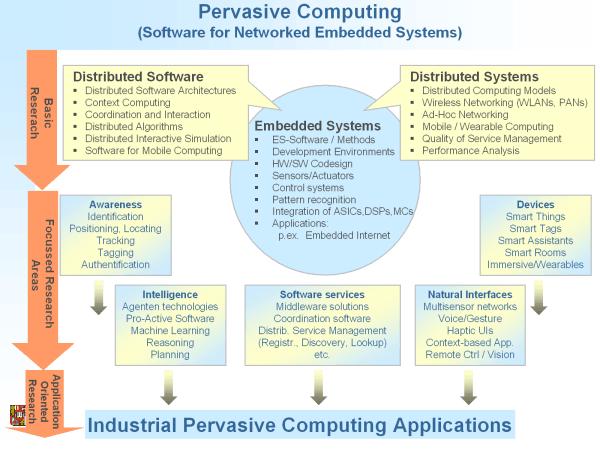
Universitat Linz - Institut fur Pervasive Computing

Posted on 16:53 by Unknown


Universitat Linz - Institut für Pervasive Computing


Research situated in the following areas :

Software for mobile, ubiquitous and embedded system architectures

Coordination and interaction

Development of distributed and embedded system software

Wireless communication systems and communication software

Quality of Service Management and performance analysis

Distributed interactive (multiuser) simulation

Read More
Posted in | No comments

Tuesday, 15 June 2004

InfoBridge: Peer-to-peer location-aware virtual posters

Posted on 20:29 by Unknown


InfoBridge: The objective of this study was to leverage contextual information to support Semantic Web P2P scenarios. The study was conducted on Carnegie Mellon Univesity's campus, leveragring the campus�s Wireless LAN (WLAN) and the MyCampus Semantic Web environment developed by the Mobile Commerce Laboratory over the past few years. Within this environment, users can access a variety of context-aware applications and services from PDAs over the WLAN. Examples of contextual attributes include user location (acquired through location tracking functionality running over the WLAN), calendar information, a variety of preferences (e.g. food preferences, topics of interest), weather information, social information (e.g. classmates, teachers, etc.).

Thanks Fabien Gandon for the reference!
Read More
Posted in | No comments

Monday, 14 June 2004

Electric Elves :: University of Southern California

Posted on 21:05 by Unknown

Tied to individual user workstations, fax machines, voice, mobile devices such as cell phones and palm pilots, Electric Elves has assisted us in routine tasks, such as rescheduling meetings, selecting presenters for research meetings, tracking people's locations, organizing lunch meetings, etc. There are a number of underlying AI technologies that support the Electric Elves, including technologies devoted to agent-human interactions, agent coordination, accessing multiple heterogeneous information sources, dynamic assignment of organizational tasks, and deriving information about organization members.
Read More
Posted in | No comments

MVIS Context-Aware Mobile Systems :: University of Oulo

Posted on 07:31 by Unknown
MVIS Context-Aware Mobile Systems: "We develop components for context-aware mobile systems which perceive environmental signals, detect their context (i.e. the state of the system and its local environment) from these signals, and calculate appropriate actions for the detected context. In its simplest form, such a system can be a mobile telephone adjusting its profile based on the noise level and brightness of the environment. A service robot equipped with a vision system and a manipulator is a more complex example of context-aware mobile system. "
Read More
Posted in | No comments

J2ME devices: Real-world performance

Posted on 07:24 by Unknown


J2ME devices: Real-world performance
: "Characterizing device performance helps developers write applications that provide good user experiences. Understanding performance aids developers in understanding each device's limitations and strengths, and in tailoring applications to suit their intent. Application performance is critical in low-level computing devices. This article illustrates how the Java Wireless Competency Centre designs tests to characterize the performance of real-world J2ME (Java 2 Platform, Micro Edition) devices."
Read More
Posted in | No comments

Thursday, 10 June 2004

Software Agents for Future Mobile Communication Environments

Posted on 23:41 by Unknown
Software Agents for Future Mobile Communication Environments: "The research will investigate the role of intelligent and mobile agents in future generation, mobile communication environments. In particular, issues related to how agents can flexibly adapt their behaviour and their interactions to the characteristics of their current communication environment will be explored. "


Participants:

Shamima Paurobally

Phil Turner

Professor Nick Jennings


Read More
Posted in | No comments

MyCampus

Posted on 20:12 by Unknown


MyCampus: is a Semantic Web environment for context-aware mobile services aimed at enhancing everyday campus life at Carnegie Mellon University (CMU). The environment revolves around a growing collection of task-specific agents capable of automatically accessing a variety of contextual information about their users (e.g. context-aware restaurant concierge, context-aware message filtering agent, etc.). A central element of the myCampus architecture is its use of Semantic eWallets that support the automated discovery and access of contextual resources (e.g. personal resources, organizational resources or public web services) subject to privacy (or confidentiality) constraints specified by their users.


Gandon, F. and Sadeh, N

A Semantic eWallet to Reconcile Privacy and Context Awareness

Second International Semantic Web Conference. Florida. 2003.

Read More
Posted in | No comments

The CyberDesk project

Posted on 08:49 by Unknown

The CyberDesk project is aimed at providing a software architecture that dynamically integrates software modules. This integration is driven by a user's context, where context includes the user's physical, social, emotional , and mental (focus-of-attention) environments. While a user's context changes in all settings, it tends to change most frequently in a mobile setting. We have used the CyberDesk system in a desktop setting and are currently using it to build an intelligent home environment.


Anind K. Dey

Providing Architectural Support for Building Context-Aware Applications

PhD Thesis. Georgia Institute of Technology. 2000.
Read More
Posted in | No comments

Schilit :: A system architecture for context-aware mobile computing

Posted on 00:31 by Unknown

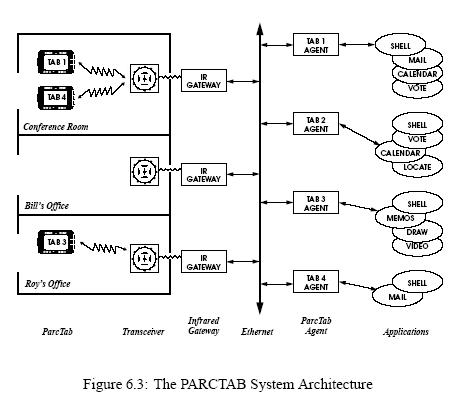
The contribution of this thesis is an architecture to support context-aware computing; that is, application adaptation triggered by such things as the location of use, the collection of nearby people, the presence of accessible devices and other kinds of objects, as well as changes to all these things over time. Three key issues are addressed: (1) the information needs of applications, (2) where applications get various pieces of information and (3) how information can be efficiently distributed. A dynamic environment communication model is introduced as a general mechanism for quickly and efficiently learning about changes occurring in the environment in a fault tolerant manner. For purposes of scalability, multiple dynamic environment servers store user, device, and, for each geographic region, context information. In order to efficiently disseminate information from these components to applications, a dynamic collection of multicast groups is employed. The thesis also describes a demonstration system based on the Xerox PARCTAB, a wireless palmtop computer.


William Noah Schilit

A system architecture for context-aware mobile computing


Phd Thesis. Columbia University. 1995.
Read More
Posted in | No comments

Wednesday, 9 June 2004

Software agents to support mobile services

Posted on 06:08 by Unknown


The rationale of designing and developing m-services it to offer

new opportunities to wireless devices-oriented users. It happens

that these users postpone their operations because they lack

appropriate facilities on their devices. Thus, it is important to

support such users by allowing them: 1) to search for additional

facilities, when needed, 2) to fetch these facilities to their wireless

devices, and 3) to conduct the operations 1, 2) in a transparent

way. A solution to 1) consists of creating brokering mechanisms.

A solution to 2) consists of using wireless communication

mechanisms. Finally, a solution to 3) consists of using software

agents.


Zakaria Maamar and Wathiq Mansoor and Qusay H. Mahmoud

Software agents to support mobile services

Proceedings of the first international joint conference on Autonomous agents and multiagent systems (AAMAS): part 2. pp 666--667. 2002.
Read More
Posted in | No comments

Pervasive Computing: What Is It Good For?

Posted on 05:20 by Unknown


"The natural target for pervasive computing is data management -- devices will accept information from the context it is originated and deliver this information in the context it is most useful. For example, the user learns he needs to buy more soft drink when getting the last can from his fridge and this information is added to his shopping list. However, it will be more useful to recall the user about his shopping list when he is nearby or inside a supermarket."


Andrew C. Huang and Benjamin C. Ling and Shankar Ponnekanti

Pervasive Computing: What Is It Good For?


1st ACM international workshop on Data engineering for wireless and mobile access. pp 84--91. Seattle, USA.
Read More
Posted in | No comments

Project CRUMPET

Posted on 00:04 by Unknown


Project CRUMPET:

The overall aim of CRUMPET is to implement, validate, and trial tourism-related value-added services for nomadic users (across mobile and fixed networks). In particular the use of agent technology will be evaluated (in terms of user-acceptability, performance and best-practice) as a suitable approach for fast creation of robust, scalable, seamlessly accessible nomadic services. The implementation will be based on a standards-compliant open source agent framework, extended to support nomadic applications, devices, and networks.
Read More
Posted in | No comments

Tuesday, 8 June 2004

SOCAM -- A Middleware for Context-Aware Mobile Services

Posted on 04:41 by Unknown


SOCAM -- A Middleware for Context-Aware Mobile Services: "In this paper, we present a Service-oriented Context-Aware Middleware (SOCAM) architecture for the building of context-aware mobile services and rapid prototyping of context-aware systems. We propose an ontology-oriented approach to support context reasoning and context knowledge sharing, and a service-oriented approach to support interoperability between different context-aware systems. We also propose a formal context model based on ontology using Web Ontology Language (OWL) to address issues including semantic context representation, capturing context classification information, and enabling context reasoning and context knowledge sharing."


T. Gu, H. K. Pung, D. Q. Zhang

A Middleware for Building Context-Aware Mobile Services

IEEE Vehicular Technology Conference (VTC-Spring 2004). Milan, Italy. 2004.

Read More
Posted in | No comments

A survey of context-aware mobile computing research

Posted on 03:29 by Unknown
A survey of context-aware mobile computing research: In this survey of research on context-aware systems and applications, we looked in depth at the types of context used and models of context information, at systems that support collecting and disseminating context, and at applications that adapt to the changing context. Through this survey, it is clear that context-aware research is an old but rich area for research. The difficulties and possible solutions we outline serve as guidance for researchers hoping to make context-aware computing a reality.
Read More
Posted in | No comments

Monday, 7 June 2004

Agent-Based Software Engineering

Posted on 21:55 by Unknown
Agent-Based Software Engineering: "Agent-Based Software Engineering

Agent-Oriented Software Engineering,

Lecture Notes in AI, Springer-Verlag 1957, 2001, pp 58-76.

Charles Petrie

Abstract: It has previously been claimed that agent technologies facilitate software development by virtue of their high-level abstractions for interactions. We address a more specific characterization and utility. We believe that it is important to distinguish agent technologies from other software technologies by virtue of a set of unique software characteristics."
Read More
Posted in | No comments

The Challenges of Mobile Computing

Posted on 20:53 by Unknown
The Challenges of Mobile Computing

(An editted version of this paper appeared in IEEE Computer, April 1994.)

This paper is a survey of the fundamental software design pressures particular to mobile computing. Promising approaches to address the problems are identified, along with their shortcomings.
Read More
Posted in | No comments

Agentlab at the University of Melbourne

Posted on 18:12 by Unknown
Agentlab at the University of Melbourne: "The Intelligent Agent Laboratory (Agentlab) is an active research group conducted jointly between the Departments of Computer Science and Software Engineering and Information systems. Both Departments share the new ICT building at the the University of Melbourne located in the very livable city of Melbourne. Founded in 1994, the Agentlab has a long history of research into intelligent agents and multi-agent systems. Over this period the Agentlab has generated a large body of agent related publications."


Context-aware applications


Agent-oriented software engineering
Read More
Posted in | No comments

MSNBC - Your Next Computer

Posted on 17:50 by Unknown
MSNBC - Your Next Computer: "There are 1.5 billion mobile phones in the world today. Already you can use them to browse the Web, take pictures, send e-mail and play games. Soon they could make your PC obsolete"
Read More
Posted in | No comments

eBiquity.ORG

Posted on 17:38 by Unknown
eBiquity.ORG : "eBiquity.ORG is a Slashdot-like portal for news and research development in Pervasive Computing. Intended scope covers devices, communication technology/protocols, infrastructure, middleware, software architectures, mobility, applications, m-commerce, and theory. "
Read More
Posted in | No comments

What is context-awareness?

Posted on 10:12 by Unknown

Context is any information that can be used to characterize the situation of an entity. An entity is a person, place, or object that is considered relevant to the interaction between a user and an application, including the user and applications themselves.

A system is context-aware if it uses context to provide relevant information and/or services to the user, where relevancy depends on the user's task.


Towards a Better Understanding of Context and Context-Awareness -- Anind K. Dey and Gregory D. Abowd (1999)

Read More
Posted in | No comments

Agent-Based Software Development

Posted on 09:59 by Unknown

This unique new reference offers a thorough and comprehensive explanation of the methods, tools, standards and techniques used to develop software using the agent-oriented approach. Meeting a long unmet need to support the agent-software development community with practical guidance in this cutting-edge area, this authoritative resource helps you to: understand the issues in developing agent-based software, select tools and techniques that aid in the development of agent systems, and become familiar with important methodologies that can be used to build different types of agent systems.


Check it at Michael Luck's web site.


Congrats Michael, Ronald and Mark for this outstanding job!

Read More
Posted in | No comments

Pervasive 2004, April 18-23, Linz / Vienna, Austria

Posted on 06:07 by Unknown
Pervasive 2004, April 18-23, Linz / Vienna, Austria


Second Intenational Conference on Pervasive Computing.

Hot Spot Papers!
Read More
Posted in | No comments

The CyberGuide project

Posted on 03:18 by Unknown
Cyberguide Project Page: "The CyberGuide project focuses on how portable computers can assist in exploring physical spaces and cyberspaces. We are developing handheld intelligent tour guides to demonstrate future computing environments"


Gregory Abowd and Christopher Atkeson and Jason Hong and Sue Long and Rob Kooper and Mike Pinkerton

Cyberguide: A mobile context-aware tour guide


ACM Wireless Networks (3). pp 421—433. 1997.

Read More
Posted in | No comments

MIT Project Oxygen

Posted on 03:05 by Unknown
MIT Project Oxygen


"In the future, computation will be human-centered. It will be freely available everywhere, like batteries and power sockets, or oxygen in the air we breathe. It will enter the human world, handling our goals and needs and helping us to do more while doing less. "
Read More
Posted in | No comments

IBM Systems Journal - Vol. 38, No. 4, 1999 - Pervasive computing

Posted on 03:01 by Unknown
IBM Systems Journal - Vol. 38, No. 4, 1999 - Pervasive computing


Pervasive computing encompasses the dramatically expanding sphere of computers embedded within and intrinsically part of larger devices. This issue presents an essay and eleven papers on the underlying technologies and the human impact of this field

Read More
Posted in | No comments

Sunday, 6 June 2004

Xerox PARCTAB

Posted on 23:24 by Unknown
Xerox PARCTAB


"The PARCTAB system is a research prototype developed at Xerox PARC to explore the capabilities and impact of mobile computers in an office setting. This research is part of PARC's Ubiquitous Computing research program."


A pioneer research on the use of mobile computing in office environments back in 1993 (!).


Check also the:


Technical Report CSL-93-20


The PARCTAB Mobile Computing System

Bill N. Schilit, Norman Adams, Rich Gold, Michael Tso and Roy Want


Read More
Posted in | No comments

The world is not a desktop :: Mark Weiser

Posted on 22:47 by Unknown
"What is the metaphor for the computer of the future? The intelligent agent? The television (multimedia)? The 3-D graphics world (virtual reality)? The StarTrek ubiquitous voice computer? The GUI desktop, honed and refined? The machine that magically grants our wishes? I think the right answer is "none of the above", because I think all of these concepts share a basic flaw: they make the computer visible."


This article presents a broad discussion of the 'technology of the future".


Mark Weiser

The world is not a desktop

Perspectives article for ACM Interactions. 1993.
Read More
Posted in | No comments

The Computer for the 21st Century :: Mark Weiser

Posted on 22:40 by Unknown
"The most profound technologies are those that disappear. They weave themselves into the fabric of everyday life until they are indistinguishable from it. "

In this excellent paper, Mark Weiser gives a glimpse of the next generation computer device and put pervasiveness and mobile computing in perspective!


Mark Weiser

The Computer for the 21st Century

Scientific American Ubicomp Paper. 1991.


Read More
Posted in | No comments
Newer Posts Home
Subscribe to: Comments (Atom)

Popular Posts

  • The Computer for the 21st Century :: Mark Weiser
    "The most profound technologies are those that disappear. They weave themselves into the fabric of everyday life until they are indisti...
  • The CyberGuide project
    Cyberguide Project Page : "The CyberGuide project focuses on how portable computers can assist in exploring physical spaces and cybersp...
  • The world is not a desktop :: Mark Weiser
    "What is the metaphor for the computer of the future? The intelligent agent? The television (multimedia)? The 3-D graphics world (virtu...
  • The CyberDesk project
    The CyberDesk project is aimed at providing a software architecture that dynamically integrates software modules. This integration is driven...
  • What is context-awareness?
    Context is any information that can be used to characterize the situation of an entity. An entity is a person, place, or object that is cons...
  • HP Cooltown
    HP Cooltown : "(...) the intersection of nomadicity, appliances, networking, and the web. We called our vision of the future cooltown -...
  • Project Aura :: Distraction-free Ubiquitous Computing
    " Project Aura will fundamentally rethink system design to address this problem. Aura's goal is to provide each user with an invis...
  • Agent-Based Software Development
    This unique new reference offers a thorough and comprehensive explanation of the methods, tools, standards and techniques used to develop so...
  • HomeLab :: Environmental Interfaces
    Environmental Interfaces: HomeLab : "This project represents a new breed of interface called an "environmental interface." We...
  • MOSES :: Mobile Services
    MOSES - Mobile Services : "We aim to develop innovative mobile services and the corresponding supporting technology and platforms. Our ...

Blog Archive

  • ►  2013 (2)
    • ►  November (1)
    • ►  September (1)
  • ▼  2004 (51)
    • ►  September (1)
    • ►  August (3)
    • ►  July (9)
    • ▼  June (38)
      • Context Broker Architecture (CoBrA)
      • Project DIAMOnDS :: Distributed Agents for Mobile ...
      • Towards an intelligent mobile travel assistant (Pa...
      • Portolano Project
      • Endeavour Project :: Charting the Fluid Informatio...
      • Project Aura :: Distraction-free Ubiquitous Computing
      • HP Cooltown
      • Network abstractions for context-aware mobile comp...
      • GRASS: GeneRic Architectures for Smart Spaces
      • Providing Architectural Support for Building Conte...
      • Universitat Linz - Institut fur Pervasive Computing
      • InfoBridge: Peer-to-peer location-aware virtual po...
      • Electric Elves :: University of Southern California
      • MVIS Context-Aware Mobile Systems :: University of...
      • J2ME devices: Real-world performance
      • Software Agents for Future Mobile Communication En...
      • MyCampus
      • The CyberDesk project
      • Schilit :: A system architecture for context-aware...
      • Software agents to support mobile services
      • Pervasive Computing: What Is It Good For?
      • Project CRUMPET
      • SOCAM -- A Middleware for Context-Aware Mobile Ser...
      • A survey of context-aware mobile computing research
      • Agent-Based Software Engineering
      • The Challenges of Mobile Computing
      • Agentlab at the University of Melbourne
      • MSNBC - Your Next Computer
      • eBiquity.ORG
      • What is context-awareness?
      • Agent-Based Software Development
      • Pervasive 2004, April 18-23, Linz / Vienna, Austria
      • The CyberGuide project
      • MIT Project Oxygen
      • IBM Systems Journal - Vol. 38, No. 4, 1999 - Perva...
      • Xerox PARCTAB
      • The world is not a desktop :: Mark Weiser
      • The Computer for the 21st Century :: Mark Weiser
Powered by Blogger.

About Me

Unknown
View my complete profile